Turning Service Insights into Product Innovation
[Overview]
The Context
Axon provides IT services and SaaS solutions to businesses. As Lead UX Designer, I worked across its service ecosystem, using service design to understand how operations, employees and customers interacted.
The Challenge
Service blueprinting revealed inefficiencies in Axon's IT support operations. Engineers were spending significant time completing repetitive user management tasks, reducing capacity for higher-value work and affecting service profitability.
The opportunity was to turn these insights into a commercially viable product that could improve efficiency and support future customer self-service.
Key Contributions
Led service blueprinting across IT support operations.
Analysed service performance data to establish the business case for automation.
Conducted research with engineers to identify needs and workflow challenges.
Defined the User Management Tool's MVP scope and phased product strategy.
Led UX/UI design, usability testing and design system development.
Collaborated with leadership and developers to deliver the product.
Skills Demonstrated
Service Design
Service Blueprinting
Mixed-Methods Research
Product Strategy
Service Blueprinting
UX Research
Data Analysis
SaaS Product Design
Stakeholder Alignment
Design Systems
[Impact]
01 — Identified a Significant Efficiency Opportunity
Service blueprinting and operational analysis revealed engineers spent approximately two hours per day on repetitive user management tasks, providing a measurable business case for automation.
02 — Improved Operational Efficiency
The User Management Tool's first release delivered a reported 40% improvement in engineer efficiency, reducing time spent on routine administration and increasing capacity for higher-value work.
03 — Established a Foundation for Scalable Self-Service
Created a modular product and phased delivery strategy that supported immediate operational improvements while laying the groundwork for future customer self-service.
[My Process]
01 — Mapping the Service Ecosystem
Understanding how the business really operated
I led service blueprinting to understand how Axon's IT support services operated across people, processes and systems.
By mapping the end-to-end service, I identified operational friction, repetitive tasks and gaps in performance reporting that were difficult to see when examining individual interactions.
02 — Building the Business Case
Turning service insights into commercial opportunities
Working with business leaders, I helped establish performance reporting and analysed service data to understand the cost of inefficient workflows.
The analysis revealed engineers spent approximately two hours each day on repetitive user management tasks.
This evidence helped justify investment in a dedicated User Management Tool, connecting the design opportunity directly to profitability and operational capacity.
03 — Defining the Right Product
Translating research into a focused MVP
I interviewed 12 support engineers, analysed recurring support tickets and mapped the workflows behind common user management requests.
The research informed four core workflows: user creation, access permissions, account modification and user removal.
I translated these findings into product requirements and prioritised functionality with stakeholders, balancing user needs, commercial value and technical feasibility.
04 — Designing and Delivering the Solution
Simplifying complex workflows through iterative design
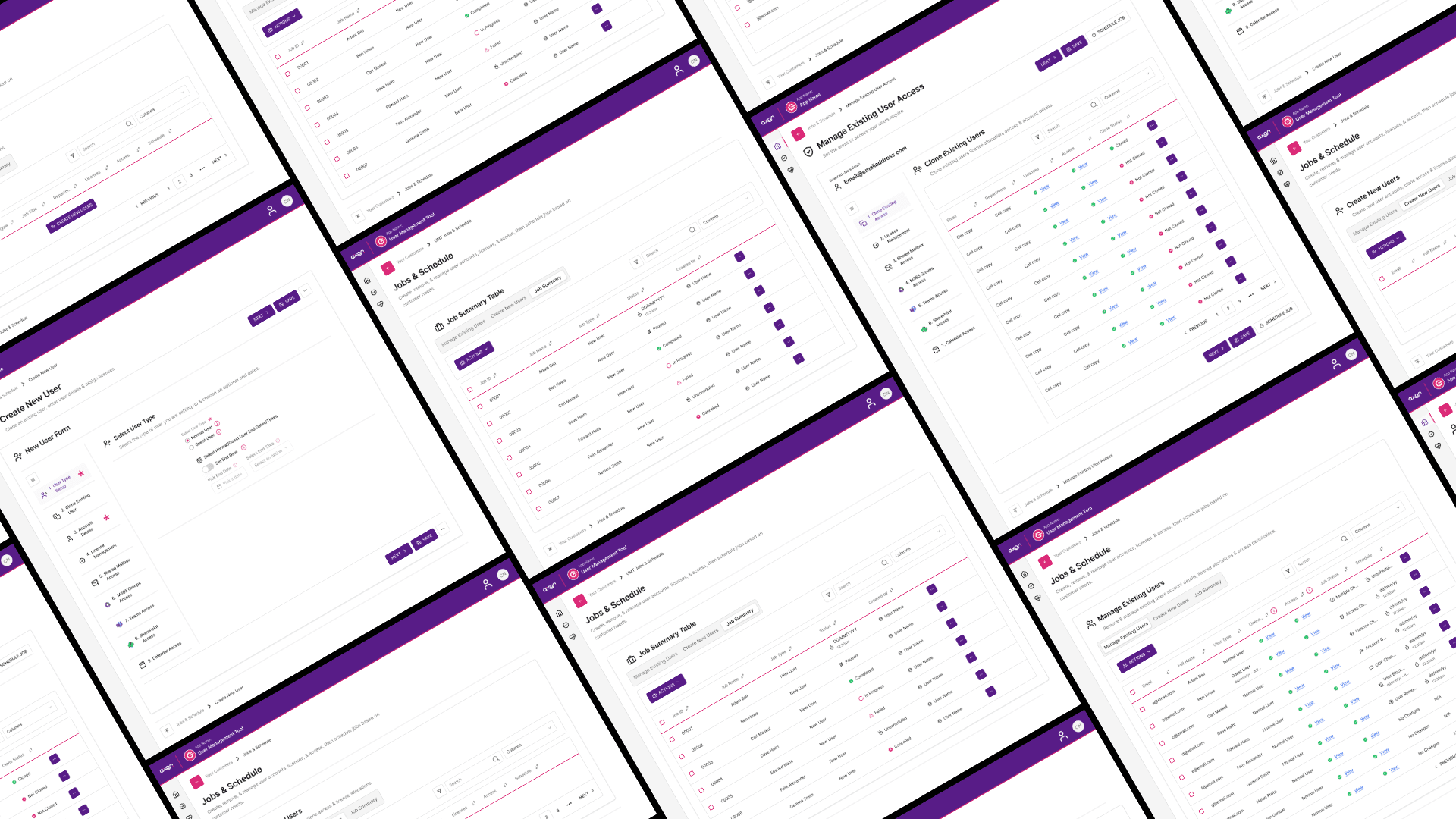
I designed and tested the User Management Tool with engineers, refining its navigation, information hierarchy and interaction patterns.
Research also revealed a need to schedule future-dated tasks, leading to the introduction of a job scheduler.
I developed a modular Figma design system and worked closely with developers to deliver a consistent, scalable product.
The first release demonstrated measurable efficiency improvements and provided evidence for further investment.
[Key Learnings]
01 — Service Design Reveals Product Opportunities
Mapping an entire service can uncover systemic problems that individual interface improvements cannot solve.
02 — Commercial Evidence Strengthens Design Decisions
Connecting operational data to financial impact helps turn UX insights into investment decisions.
03 — Design for Immediate Value and Long-Term Scale
A focused MVP can deliver measurable improvements while establishing a foundation for future automation and self-service.
Turning Service Insights into Product Innovation
[Overview]
The Context
Axon provides IT services and SaaS solutions to businesses. As Lead UX Designer, I worked across its service ecosystem, using service design to understand how operations, employees and customers interacted.
The Challenge
Service blueprinting revealed inefficiencies in Axon's IT support operations. Engineers were spending significant time completing repetitive user management tasks, reducing capacity for higher-value work and affecting service profitability.
The opportunity was to turn these insights into a commercially viable product that could improve efficiency and support future customer self-service.
Key Contributions
Led service blueprinting across IT support operations.
Analysed service performance data to establish the business case for automation.
Conducted research with engineers to identify needs and workflow challenges.
Defined the User Management Tool's MVP scope and phased product strategy.
Led UX/UI design, usability testing and design system development.
Collaborated with leadership and developers to deliver the product.
Skills Demonstrated
Service Design
Service Blueprinting
Product Strategy
UX Research
Data Analysis
SaaS Product Design
Stakeholder Alignment
Design Systems
[Impact]
01 — Identified a Significant Efficiency Opportunity
Service blueprinting and operational analysis revealed engineers spent approximately two hours per day on repetitive user management tasks, providing a measurable business case for automation.
02 — Improved Operational Efficiency
The User Management Tool's first release delivered a reported 40% improvement in engineer efficiency, reducing time spent on routine administration and increasing capacity for higher-value work.
03 — Established a Foundation for Scalable Self-Service
Created a modular product and phased delivery strategy that supported immediate operational improvements while laying the groundwork for future customer self-service.
[Key Learnings]
01 — Service Design Reveals Product Opportunities
Mapping an entire service can uncover systemic problems that individual interface improvements cannot solve.
02 — Commercial Evidence Strengthens Design Decisions
Connecting operational data to financial impact helps turn UX insights into investment decisions.
03 — Design for Immediate Value and Long-Term Scale
A focused MVP can deliver measurable improvements while establishing a foundation for future automation and self-service.
[My Process]
01 — Mapping the Service Ecosystem
Understanding how the business really operated
I led service blueprinting to understand how Axon's IT support services operated across people, processes and systems.
By mapping the end-to-end service, I identified operational friction, repetitive tasks and gaps in performance reporting that were difficult to see when examining individual interactions.
02 — Building the Business Case
Turning service insights into commercial opportunities
Working with business leaders, I helped establish performance reporting and analysed service data to understand the cost of inefficient workflows.
The analysis revealed engineers spent approximately two hours each day on repetitive user management tasks.
This evidence helped justify investment in a dedicated User Management Tool, connecting the design opportunity directly to profitability and operational capacity.
03 — Defining the Right Product
Translating research into a focused MVP
I interviewed 12 support engineers, analysed recurring support tickets and mapped the workflows behind common user management requests.
The research informed four core workflows: user creation, access permissions, account modification and user removal.
I translated these findings into product requirements and prioritised functionality with stakeholders, balancing user needs, commercial value and technical feasibility.
04 — Designing and Delivering the Solution
Simplifying complex workflows through iterative design
I designed and tested the User Management Tool with engineers, refining its navigation, information hierarchy and interaction patterns.
Research also revealed a need to schedule future-dated tasks, leading to the introduction of a job scheduler.
I developed a modular Figma design system and worked closely with developers to deliver a consistent, scalable product.
The first release demonstrated measurable efficiency improvements and provided evidence for further investment.