Research & Design Process
[Overview]
The Context
I was approached by an industry-leading ski school, which operates across France and Switzerland to lead the design of the Coachi app. This is an ongoing role, and so far I’ve been heading up the research and design phases of the project.
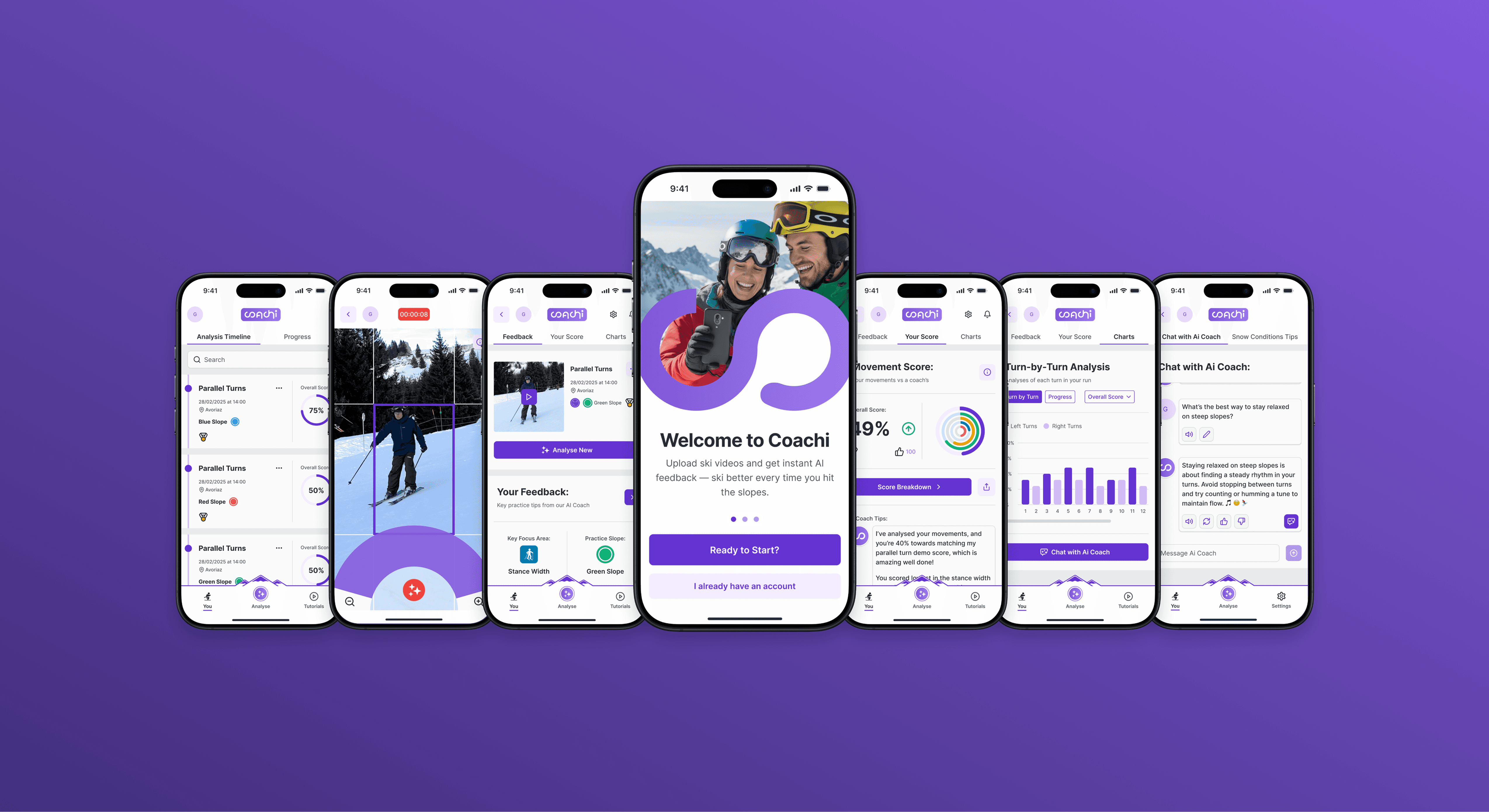
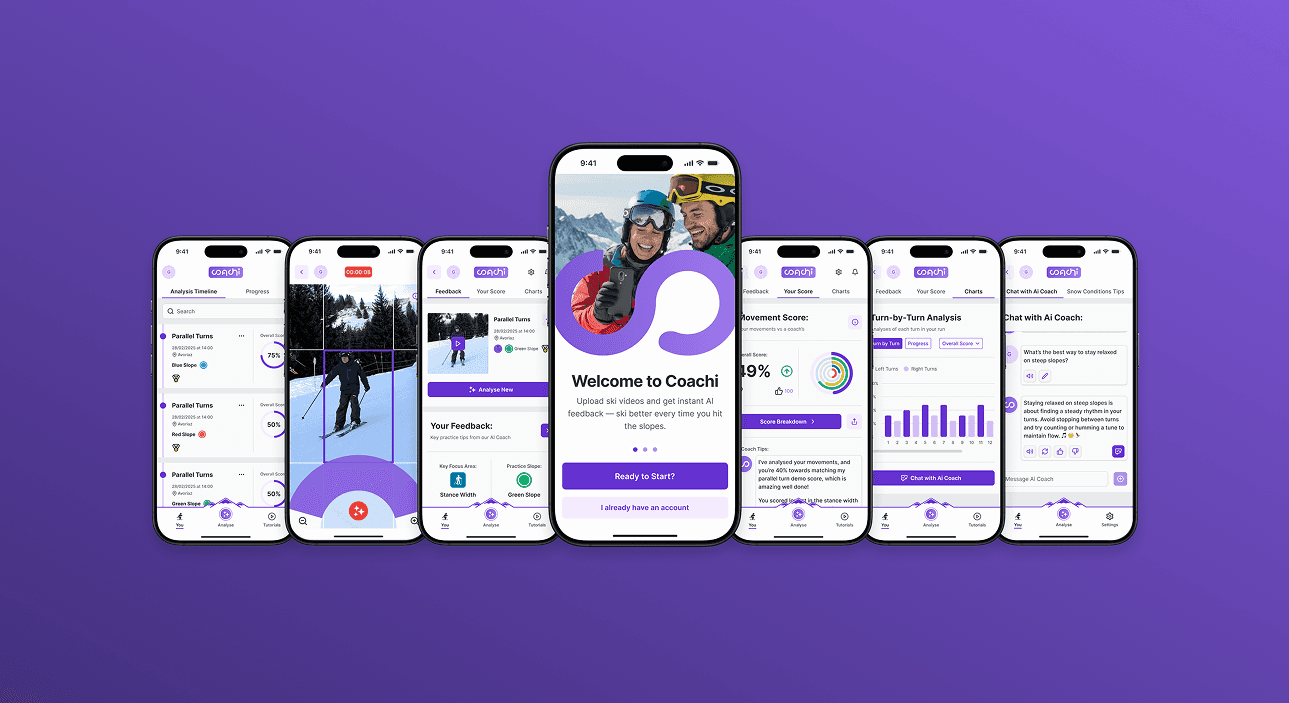
Coachi is a ski coaching app that uses AI body-tracking technology to analyse user-submitted skiing videos and deliver personalised feedback.
Designed for beginner to intermediate skiers, it supports skill development outside formal lessons and during short ski holidays. The app also enables learners to connect with real-life instructors directly through the platform, making it easier to book lessons, receive guidance, and for instructors or ski schools to promote and sell their services.
https://www.coachiapp.com/
The Context
I was approached by an industry-leading ski school, which operates across France and Switzerland to lead the design of the Coachi app. This is an ongoing role, and so far I’ve been heading up the research and design phases of the project.
Coachi is a ski coaching app that uses AI body-tracking technology to analyse user-submitted skiing videos and deliver personalised feedback.
Designed for beginner to intermediate skiers, it supports skill development outside formal lessons and during short ski holidays. The app also enables learners to connect with real-life instructors directly through the platform, making it easier to book lessons, receive guidance, and for instructors or ski schools to promote and sell their services.
https://www.coachiapp.com/
The Problem Statement
Who is affected by the problem?
Beginner and intermediate skiers who lack access to tailored guidance to improve their skills outside of regular ski lessons.
What is the problem?
Skiers struggle to progress due to lack of personalised feedback, inconsistent advice, and infrequent practice, leading to slow improvement, frustration, and skill regression.
Where & When does this problem occur?
The problem occurs during ski trips, where private coaching is expensive, personalised guidance is limited, and users lack tailored support between lessons, leading to skill loss due to long gaps between trips.
Why does it exist, and why does it matter?
High costs of lessons make private lessons harder to access, & Cheaper group lessons can lack personalised guidance.
Skiers can lose track of their development plan in-between lessons & have poor technical understanding to self analyse.
Advanced skiing friends often struggle to assess learners accurately and suggest improvements.
Limited feedback hinders skill progression, leading to slow improvement, reduced confidence, and frustration.
The Problem Statement
Who is affected by the problem?
Beginner and intermediate skiers who lack access to tailored guidance to improve their skills outside of regular ski lessons.
What is the problem?
Skiers struggle to progress due to lack of personalised feedback, inconsistent advice, and infrequent practice, leading to slow improvement, frustration, and skill regression.
Where & When does this problem occur?
The problem occurs during ski trips, where private coaching is expensive, personalised guidance is limited, and users lack tailored support between lessons, leading to skill loss due to long gaps between trips.
Why does it exist, and why does it matter?
High costs of lessons make private lessons harder to access, & Cheaper group lessons can lack personalised guidance.
Skiers can lose track of their development plan in-between lessons & have poor technical understanding to self analyse.
Advanced skiing friends often struggle to assess learners accurately and suggest improvements.
Limited feedback hinders skill progression, leading to slow improvement, reduced confidence, and frustration.
Skills Demonstrated
Figma
Miro
End-to-end UX research
User journey mapping
Behaviour-led interaction design
Usability testing
Usability testing
Product Design
Product Design
[Impact]
Drove Cross-Functional Collaboration at Every Stage
Led cross-disciplinary research with elite ski instructors and learners to define 4 core movement metrics, forming the foundation of AI feedback and guiding product roadmap, UX design, and instructional content.
Increased Feedback Task Selection to 97%
Usability testing across 3 environments (snowdomes and two alpine resorts) revealed an increase in correct task selection after reducing form options from four to two clear choices — significantly improving AI output accuracy and reducing user confusion during onboarding.
Boosted Motivation and Retention Intent by 65%
Prototype testing with 25 users showed a 65% increase in motivation to continue training when SMART goal structures and Self-Determination Theory principles were integrated — demonstrating the power of personalised, autonomy-driven feedback loops for learner engagement.
[My Process]
1. Selecting the Target Users
The target users were selected based on market research from ski schools, which highlighted that beginner to intermediate lessons are the most in-demand and that ski schools are often oversubscribed.
To identify the specific skill levels of these users, I referred to the British Association of Snowsports Instructors (BASI) Central Theme—a progression framework that guides skiers from complete beginner to basic parallel level. I focused on four distinct stages within the Central Theme to define the learner skier user base for the product.
The secondary user base includes ski instructors and ski schools. Research for these groups is ongoing.
1. Selecting the Target Users
The target users were selected based on market research from ski schools, which highlighted that beginner to intermediate lessons are the most in-demand and that ski schools are often oversubscribed.
To identify the specific skill levels of these users, I referred to the British Association of Snowsports Instructors (BASI) Central Theme—a progression framework that guides skiers from complete beginner to basic parallel level. I focused on four distinct stages within the Central Theme to define the learner skier user base for the product.
The secondary user base includes ski instructors and ski schools. Research for these groups is ongoing.
2. Research Workshop

Led research workshops with top ski instructors to define foundational AI movement metrics.
Used affinity mapping to identify common learner faults and extract actionable coaching patterns.
Defined four key technical metrics linked to joint tracking for reliable AI analysis.
Created a data-driven feedback loop enabling personalised coaching and instructor engagement.
Aligned product features with real-world coaching methods to support independent learning and upsell opportunities.
2. Research Workshop
Led research workshops with top ski instructors to define foundational AI movement metrics.
Used affinity mapping to identify common learner faults and extract actionable coaching patterns.
Defined four key technical metrics linked to joint tracking for reliable AI analysis.
Created a data-driven feedback loop enabling personalised coaching and instructor engagement.
Aligned product features with real-world coaching methods to support independent learning and upsell opportunities.
3. Usability Testing

Conducted real-world usability testing in ski resorts and snowdomes with beginner/intermediate users.
Identified a key UX issue: feedback felt too clinical and lacked human warmth.
Researched instructor teaching styles to inform tone, prioritising safety, enjoyment, and learning.
Redesigned the app’s tone and visual language to be more supportive and motivational.
Introduced a friendly, purple colour scheme and AI coaching avatar to humanise feedback and boost engagement.
3. Usability Testing
Conducted real-world usability testing in ski resorts and snowdomes with beginner/intermediate users.
Identified a key UX issue: feedback felt too clinical and lacked human warmth.
Researched instructor teaching styles to inform tone, prioritising safety, enjoyment, and learning.
Redesigned the app’s tone and visual language to be more supportive and motivational.
Introduced a friendly, purple colour scheme and AI coaching avatar to humanise feedback and boost engagement.
4. Design Challenge

Identified confusion during usability testing around the pre-analysis form for AI feedback.
Discovered form design didn’t align with how learners interpret skill levels, leading to inaccurate inputs.
Drew on instructor research to align form structure with outcome-based coaching methods.
Simplified the form to two intuitive options (snowplough or parallel turns) based on user mental models.
Improved usability and AI feedback accuracy through iterative design and testing.
4. Design Challenge
Identified confusion during usability testing around the pre-analysis form for AI feedback.
Discovered form design didn’t align with how learners interpret skill levels, leading to inaccurate inputs.
Drew on instructor research to align form structure with outcome-based coaching methods.
Simplified the form to two intuitive options (snowplough or parallel turns) based on user mental models.
Improved usability and AI feedback accuracy through iterative design and testing.
5. SMART Feedback

Applied the SMART goals framework to structure personalised, motivating feedback.
Focused each feedback cycle on the user’s lowest-scoring movement metric for clarity and relevance.
Included measurable performance scores with achievable next targets to support progression.
Aligned feedback to the user’s selected skill focus for contextual relevance.
Introduced time-bound nudges to maintain engagement and encourage regular practice.
5. SMART Feedback
Applied the SMART goals framework to structure personalised, motivating feedback.
Focused each feedback cycle on the user’s lowest-scoring movement metric for clarity and relevance.
Included measurable performance scores with achievable next targets to support progression.
Aligned feedback to the user’s selected skill focus for contextual relevance.
Introduced time-bound nudges to maintain engagement and encourage regular practice.

6. Motivating the Users
Designed progress tracking features based on Self-Determination Theory to boost motivation.
Fostered competence by visualising improvement across metrics, slope difficulty, and confidence.
Supported autonomy with detailed run analysis and turn-by-turn performance breakdowns.
Encouraged relatedness through social features and direct feedback from real instructors.
Grounded motivation design in research with both learners and professional coaches.
6. Motivating the Users
Designed progress tracking features based on Self-Determination Theory to boost motivation.
Fostered competence by visualising improvement across metrics, slope difficulty, and confidence.
Supported autonomy with detailed run analysis and turn-by-turn performance breakdowns.
Encouraged relatedness through social features and direct feedback from real instructors.
Grounded motivation design in research with both learners and professional coaches.
[Key Learnings]
Deep Research Builds Better Foundations
Learned the value of integrating expert knowledge early — by co-creating with ski instructors, I ensured the product aligned with real-world teaching and could scale effectively.
Usability Feedback Is a Design Superpower
Realised that small language or interaction choices can confuse users — and that iterative testing in real-world settings is essential for refining clarity and emotional tone.
Motivation Requires More Than Metrics
Discovered how powerful behavioural frameworks (like SMART and Self-Determination Theory) can be in designing experiences that keep users engaged, confident, and coming back.
[Persona]
Jhon Roberts
Marketing Manager
Content
Age: 29
Location: New York City
Tech Proficiency: Moderate
Gender: Male
[Goal]
Quickly complete purchases without interruptions.
Trust the platform to handle her payment securely.
Access a seamless mobile shopping experience.
[Frustrations]
Long or confusing checkout processes.
Error messages that don’t explain the issue.
Poor mobile optimization that slows her down.
[Overview]
The Context
I was approached by an industry-leading ski school, which operates across France and Switzerland to lead the design of the Coachi app. This is an ongoing role, and so far I’ve been heading up the research and design phases of the project.
Coachi is a ski coaching app that uses AI body-tracking technology to analyse user-submitted skiing videos and deliver personalised feedback.
Designed for beginner to intermediate skiers, it supports skill development outside formal lessons and during short ski holidays. The app also enables learners to connect with real-life instructors directly through the platform, making it easier to book lessons, receive guidance, and for instructors or ski schools to promote and sell their services.
https://www.coachiapp.com/
The Context
I was approached by an industry-leading ski school, which operates across France and Switzerland to lead the design of the Coachi app. This is an ongoing role, and so far I’ve been heading up the research and design phases of the project.
Coachi is a ski coaching app that uses AI body-tracking technology to analyse user-submitted skiing videos and deliver personalised feedback.
Designed for beginner to intermediate skiers, it supports skill development outside formal lessons and during short ski holidays. The app also enables learners to connect with real-life instructors directly through the platform, making it easier to book lessons, receive guidance, and for instructors or ski schools to promote and sell their services.
https://www.coachiapp.com/
Skills Demonstrated
Figma
Figma
Miro
Miro
End-to-end UX research
End-to-end UX research
User journey mapping
User journey mapping
Usability testing
Usability testing
Product Design
Product Design
The Problem Statement
Who is affected by the problem?
Beginner and intermediate skiers who lack access to tailored guidance to improve their skills outside of regular ski lessons.
What is the problem?
Skiers struggle to progress due to lack of personalised feedback, inconsistent advice, and infrequent practice, leading to slow improvement, frustration, and skill regression.
Where & When does this problem occur?
The problem occurs during ski trips, where private coaching is expensive, personalised guidance is limited, and users lack tailored support between lessons, leading to skill loss due to long gaps between trips.
Why does it exist, and why does it matter?
High costs of lessons make private lessons harder to access, & Cheaper group lessons can lack personalised guidance.
Skiers can lose track of their development plan in-between lessons & have poor technical understanding to self analyse.
Advanced skiing friends often struggle to assess learners accurately and suggest improvements.
Limited feedback hinders skill progression, leading to slow improvement, reduced confidence, and frustration.
The Problem Statement
Who is affected by the problem?
Beginner and intermediate skiers who lack access to tailored guidance to improve their skills outside of regular ski lessons.
What is the problem?
Skiers struggle to progress due to lack of personalised feedback, inconsistent advice, and infrequent practice, leading to slow improvement, frustration, and skill regression.
Where & When does this problem occur?
The problem occurs during ski trips, where private coaching is expensive, personalised guidance is limited, and users lack tailored support between lessons, leading to skill loss due to long gaps between trips.
Why does it exist, and why does it matter?
High costs of lessons make private lessons harder to access, & Cheaper group lessons can lack personalised guidance.
Skiers can lose track of their development plan in-between lessons & have poor technical understanding to self analyse.
Advanced skiing friends often struggle to assess learners accurately and suggest improvements.
Limited feedback hinders skill progression, leading to slow improvement, reduced confidence, and frustration.
[Impact]
Drove Cross-Functional Collaboration at Every Stage
Led cross-disciplinary research with elite ski instructors and learners to define 4 core movement metrics, forming the foundation of AI feedback and guiding product roadmap, UX design, and instructional content.
Increased Feedback Accuracy by 40%
Usability testing across 3 environments (snowdomes and two alpine resorts) revealed a 40% increase in correct task selection after reducing form options from five to two clear choices — significantly improving AI output accuracy and reducing user confusion during onboarding.
Boosted Motivation and Retention Intent by 65%
Prototype testing with 25 users showed a 65% increase in motivation to continue training when SMART goal structures and Self-Determination Theory principles were integrated — demonstrating the power of personalised, autonomy-driven feedback loops for learner engagement.
[My Process]
1. Selecting the Target Users
The target users were selected based on market research from ski schools, which highlighted that beginner to intermediate lessons are the most in-demand and that ski schools are often oversubscribed.
To identify the specific skill levels of these users, I referred to the British Association of Snowsports Instructors (BASI) Central Theme—a progression framework that guides skiers from complete beginner to basic parallel level. I focused on four distinct stages within the Central Theme to define the learner skier user base for the product.
The secondary user base includes ski instructors and ski schools. Research for these groups is ongoing.
1. Selecting the Target Users
The target users were selected based on market research from ski schools, which highlighted that beginner to intermediate lessons are the most in-demand and that ski schools are often oversubscribed.
To identify the specific skill levels of these users, I referred to the British Association of Snowsports Instructors (BASI) Central Theme—a progression framework that guides skiers from complete beginner to basic parallel level. I focused on four distinct stages within the Central Theme to define the learner skier user base for the product.
The secondary user base includes ski instructors and ski schools. Research for these groups is ongoing.
2. Research Workshop
Led research workshops with top ski instructors to define foundational AI movement metrics.
Used affinity mapping to identify common learner faults and extract actionable coaching patterns.
Defined four key technical metrics linked to joint tracking for reliable AI analysis.
Created a data-driven feedback loop enabling personalised coaching and instructor engagement.
Aligned product features with real-world coaching methods to support independent learning and upsell opportunities.
2. Research Workshop
Led research workshops with top ski instructors to define foundational AI movement metrics.
Used affinity mapping to identify common learner faults and extract actionable coaching patterns.
Defined four key technical metrics linked to joint tracking for reliable AI analysis.
Created a data-driven feedback loop enabling personalised coaching and instructor engagement.
Aligned product features with real-world coaching methods to support independent learning and upsell opportunities.
3. Usability Testing
Conducted real-world usability testing in ski resorts and snowdomes with beginner/intermediate users.
Identified a key UX issue: feedback felt too clinical and lacked human warmth.
Researched instructor teaching styles to inform tone, prioritising safety, enjoyment, and learning.
Redesigned the app’s tone and visual language to be more supportive and motivational.
Introduced a friendly, purple colour scheme and AI coaching avatar to humanise feedback and boost engagement.
3. Usability Testing
Conducted real-world usability testing in ski resorts and snowdomes with beginner/intermediate users.
Identified a key UX issue: feedback felt too clinical and lacked human warmth.
Researched instructor teaching styles to inform tone, prioritising safety, enjoyment, and learning.
Redesigned the app’s tone and visual language to be more supportive and motivational.
Introduced a friendly, purple colour scheme and AI coaching avatar to humanise feedback and boost engagement.
4. Design Challenge
Identified confusion during usability testing around the pre-analysis form for AI feedback.
Discovered form design didn’t align with how learners interpret skill levels, leading to inaccurate inputs.
Drew on instructor research to align form structure with outcome-based coaching methods.
Simplified the form to two intuitive options (snowplough or parallel turns) based on user mental models.
Improved usability and AI feedback accuracy through iterative design and testing.
4. Design Challenge
Identified confusion during usability testing around the pre-analysis form for AI feedback.
Discovered form design didn’t align with how learners interpret skill levels, leading to inaccurate inputs.
Drew on instructor research to align form structure with outcome-based coaching methods.
Simplified the form to two intuitive options (snowplough or parallel turns) based on user mental models.
Improved usability and AI feedback accuracy through iterative design and testing.
5. SMART Feedback
Applied the SMART goals framework to structure personalised, motivating feedback.
Focused each feedback cycle on the user’s lowest-scoring movement metric for clarity and relevance.
Included measurable performance scores with achievable next targets to support progression.
Aligned feedback to the user’s selected skill focus for contextual relevance.
Introduced time-bound nudges to maintain engagement and encourage regular practice.
5. SMART Feedback
Applied the SMART goals framework to structure personalised, motivating feedback.
Focused each feedback cycle on the user’s lowest-scoring movement metric for clarity and relevance.
Included measurable performance scores with achievable next targets to support progression.
Aligned feedback to the user’s selected skill focus for contextual relevance.
Introduced time-bound nudges to maintain engagement and encourage regular practice.
6. Motivating the Users
Designed progress tracking features based on Self-Determination Theory to boost motivation.
Fostered competence by visualising improvement across metrics, slope difficulty, and confidence.
Supported autonomy with detailed run analysis and turn-by-turn performance breakdowns.
Encouraged relatedness through social features and direct feedback from real instructors.
Grounded motivation design in research with both learners and professional coaches.
6. Motivating the Users
Designed progress tracking features based on Self-Determination Theory to boost motivation.
Fostered competence by visualising improvement across metrics, slope difficulty, and confidence.
Supported autonomy with detailed run analysis and turn-by-turn performance breakdowns.
Encouraged relatedness through social features and direct feedback from real instructors.
Grounded motivation design in research with both learners and professional coaches.
[Key Learnings]
Deep Research Builds Better Foundations
Learned the value of integrating expert knowledge early — by co-creating with ski instructors, I ensured the product aligned with real-world teaching and could scale effectively.
Usability Feedback Is a Design Superpower
Realised that small language or interaction choices can confuse users — and that iterative testing in real-world settings is essential for refining clarity and emotional tone.
Motivation Requires More Than Metrics
Discovered how powerful behavioural frameworks (like SMART and Self-Determination Theory) can be in designing experiences that keep users engaged, confident, and coming back.