Onboarding Experience
[Overview]
The Context
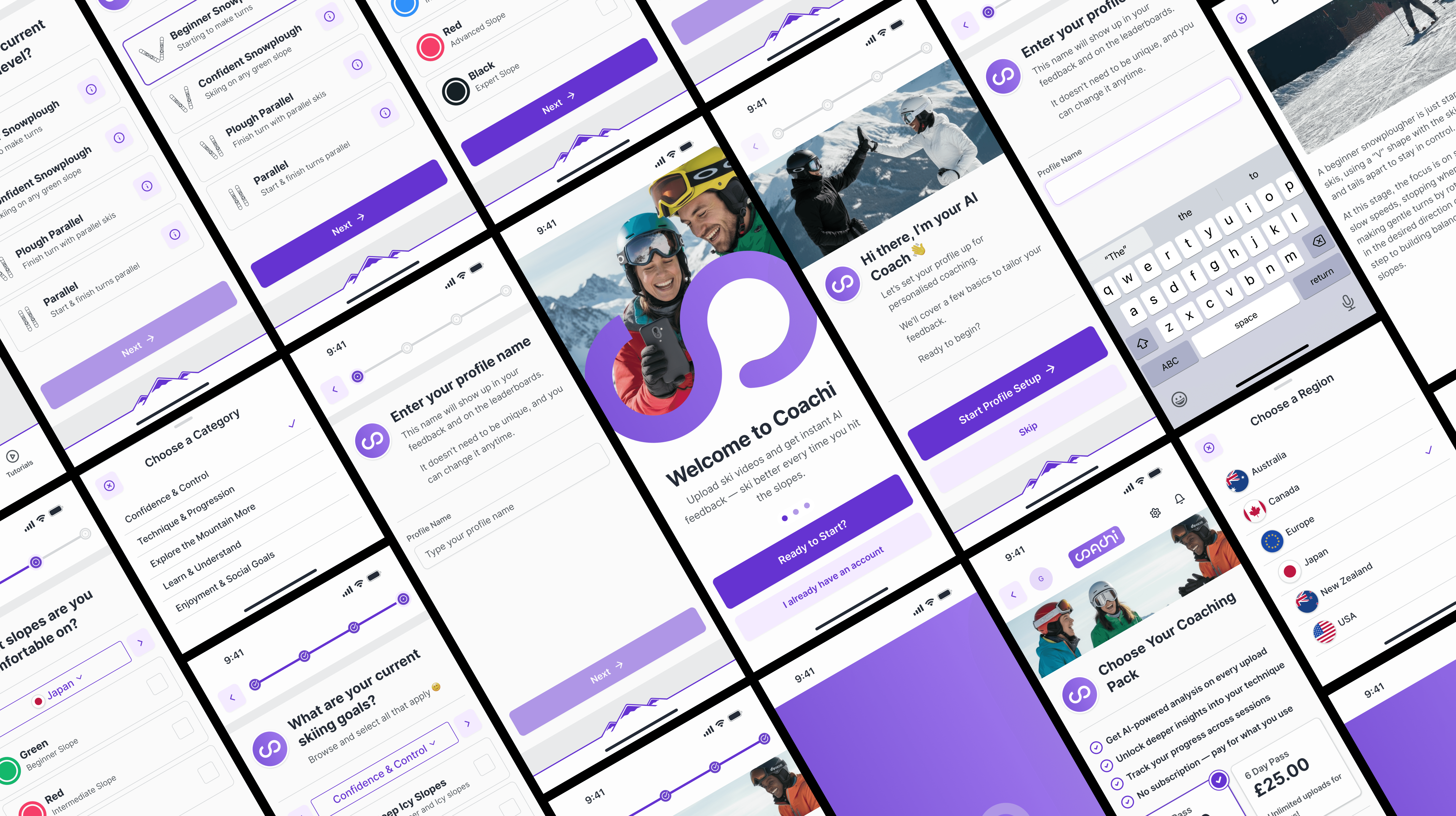
Coachi is an AI-powered ski coaching app designed to put an instructor in your pocket.
A key challenge was ensuring the experience felt personal, relevant, and learner-centred rather than generic. To achieve this, I designed the onboarding flow to replicate how instructors begin a real lesson: by gathering essential information about the learner to tailor the coaching journey.
The Context
Coachi is an AI-powered ski coaching app designed to put an instructor in your pocket.
A key challenge was ensuring the experience felt personal, relevant, and learner-centred rather than generic. To achieve this, I designed the onboarding flow to replicate how instructors begin a real lesson: by gathering essential information about the learner to tailor the coaching journey.
The Challenge
The goal of this onboarding was to capture relevant data on each learner — from skill level to motivations — and pass it to the AI coaching agent. This meant the text-based feedback learners received would be specific, actionable, and aligned with their individual goals.
In my research, I found that ski instructors spend the first part of any session asking open-ended questions, observing performance, and adjusting their approach based on context.
I drew inspiration directly from ski instructors’ fact-finding techniques and translated them into a structured onboarding process
The Challenge
The goal of this onboarding was to capture relevant data on each learner — from skill level to motivations — and pass it to the AI coaching agent. This meant the text-based feedback learners received would be specific, actionable, and aligned with their individual goals.
In my research, I found that ski instructors spend the first part of any session asking open-ended questions, observing performance, and adjusting their approach based on context.
I drew inspiration directly from ski instructors’ fact-finding techniques and translated them into a structured onboarding process
Skills Demonstrated
Figma
Figma
UX research
UX research
User Interviews
User Interviews
User journey mapping
User journey mapping
Onboarding flow design
Onboarding flow design
Mobile App Design
Mobile App Design
[Impact]
95% Usability Testing Success Rate
95% of testers successfully completed the onboarding flow without external guidance.
Reduced Time to Completion to Under 2 mins
Onboarding flow refined to under 2 minutes while still capturing all key personalisation inputs.
100% Coverage of Core Coaching Inputs
Captured 100% of data points ski instructors use to personalise real lessons — skill level, slope comfort, goals.
[My Process]
1. Personalisation

Captured the user’s name so that AI-generated feedback could be directed personally, making the coaching feel more human and conversational.
This simple step was critical to building early trust and engagement, helping learners feel the app was speaking directly to them, not at them.
The profile name is also the name that is used in the score board system which makes up part of the gamification concept within Coachi aimed at increasing learner motivation to engage and learn.
1. Personalisation
Captured the user’s name so that AI-generated feedback could be directed personally, making the coaching feel more human and conversational.
This simple step was critical to building early trust and engagement, helping learners feel the app was speaking directly to them, not at them.
The profile name is also the name that is used in the score board system which makes up part of the gamification concept within Coachi aimed at increasing learner motivation to engage and learn.
2. Skill Assessment

Designed four clear skill categories (Beginner Snowplougher → Parallel Skier) to represent the most common learner profiles observed in research.
Field studies revealed that learners often misunderstand technical skiing terminology, so I created explainer sheets with demonstration videos to help them self-identify accurately.
This approach ensured that users started with the right baseline level, avoiding frustration caused by misclassification.
2. Skill Assessment
Designed four clear skill categories (Beginner Snowplougher → Parallel Skier) to represent the most common learner profiles observed in research.
Field studies revealed that learners often misunderstand technical skiing terminology, so I created explainer sheets with demonstration videos to help them self-identify accurately.
This approach ensured that users started with the right baseline level, avoiding frustration caused by misclassification.
3. Slope Confidence

Included a step asking users which slopes they were most comfortable skiing on — a key detail instructors always assess to balance safety with challenge.
To handle regional variations in slope grading systems (e.g., Europe vs. North America), I designed a regional selector, allowing users to align slope difficulty ratings with their local standards.
This not only improved accuracy of onboarding data but also created a more globally inclusive product experience.
3. Slope Confidence
Included a step asking users which slopes they were most comfortable skiing on — a key detail instructors always assess to balance safety with challenge.
To handle regional variations in slope grading systems (e.g., Europe vs. North America), I designed a regional selector, allowing users to align slope difficulty ratings with their local standards.
This not only improved accuracy of onboarding data but also created a more globally inclusive product experience.

4. Goals & Motivation
Conducted extensive interviews and surveys with both learners and instructors to understand the most common goals (e.g., building confidence, mastering parallel turns, skiing more advanced terrain).
Synthesised this into a structured goal-selection framework, giving learners clear but flexible options to define their motivations.
By capturing this data up front, the app could personalise AI feedback to align with what truly mattered to each learner, keeping them engaged over time.
4. Goals & Motivation
Conducted extensive interviews and surveys with both learners and instructors to understand the most common goals (e.g., building confidence, mastering parallel turns, skiing more advanced terrain).
Synthesised this into a structured goal-selection framework, giving learners clear but flexible options to define their motivations.
By capturing this data up front, the app could personalise AI feedback to align with what truly mattered to each learner, keeping them engaged over time.
[Key Learnings]
Real-World Insight Drives Digital Strategy
Effective onboarding starts with understanding the real coaching experience.
By observing how instructors assess new skiers, I translated that human-first discovery process into a digital flow that feels authentic, empathetic, and tailored.
Research-Informed Personalisation
User needs aren’t just captured — they’re respected.
In-depth interviews and regional analysis led to explainer content and flexible slope grading options, ensuring the onboarding experience was inclusive and context-aware.
Onboarding as Strategic Infrastructure
Good onboarding is not a form — it’s foundational.
The structured intake directly powers Coachi’s coaching logic and feedback loop, proving that onboarding can be a critical input to both user satisfaction and product performance.
[Persona]
Jhon Roberts
Marketing Manager
Content
Age: 29
Location: New York City
Tech Proficiency: Moderate
Gender: Male
[Goal]
Quickly complete purchases without interruptions.
Trust the platform to handle her payment securely.
Access a seamless mobile shopping experience.
[Frustrations]
Long or confusing checkout processes.
Error messages that don’t explain the issue.
Poor mobile optimization that slows her down.
[Overview]
The Context
Coachi is an AI-powered ski coaching app designed to put an instructor in your pocket.
A key challenge was ensuring the experience felt personal, relevant, and learner-centred rather than generic. To achieve this, I designed the onboarding flow to replicate how instructors begin a real lesson: by gathering essential information about the learner to tailor the coaching journey.
The Context
Coachi is an AI-powered ski coaching app designed to put an instructor in your pocket.
A key challenge was ensuring the experience felt personal, relevant, and learner-centred rather than generic. To achieve this, I designed the onboarding flow to replicate how instructors begin a real lesson: by gathering essential information about the learner to tailor the coaching journey.
The Challenge
The goal of this onboarding was to capture relevant data on each learner — from skill level to motivations — and pass it to the AI coaching agent. This meant the text-based feedback learners received would be specific, actionable, and aligned with their individual goals.
In my research, I found that ski instructors spend the first part of any session asking open-ended questions, observing performance, and adjusting their approach based on context.
I drew inspiration directly from ski instructors’ fact-finding techniques and translated them into a structured onboarding process
The Challenge
The goal of this onboarding was to capture relevant data on each learner — from skill level to motivations — and pass it to the AI coaching agent. This meant the text-based feedback learners received would be specific, actionable, and aligned with their individual goals.
In my research, I found that ski instructors spend the first part of any session asking open-ended questions, observing performance, and adjusting their approach based on context.
I drew inspiration directly from ski instructors’ fact-finding techniques and translated them into a structured onboarding process
Skills Demonstrated
Figma
Figma
UX research
UX research
User Interviews
User Interviews
User journey mapping
User journey mapping
Onboarding flow design
Onboarding flow design
Mobile App Design
Mobile App Design
[My Process]
1. Personalisation
Captured the user’s name so that AI-generated feedback could be directed personally, making the coaching feel more human and conversational.
This simple step was critical to building early trust and engagement, helping learners feel the app was speaking directly to them, not at them.
The profile name is also the name that is used in the score board system which makes up part of the gamification concept within Coachi aimed at increasing learner motivation to engage and learn.
1. Personalisation
Captured the user’s name so that AI-generated feedback could be directed personally, making the coaching feel more human and conversational.
This simple step was critical to building early trust and engagement, helping learners feel the app was speaking directly to them, not at them.
The profile name is also the name that is used in the score board system which makes up part of the gamification concept within Coachi aimed at increasing learner motivation to engage and learn.
2. Skill Assessment
Designed four clear skill categories (Beginner Snowplougher → Parallel Skier) to represent the most common learner profiles observed in research.
Field studies revealed that learners often misunderstand technical skiing terminology, so I created explainer sheets with demonstration videos to help them self-identify accurately.
This approach ensured that users started with the right baseline level, avoiding frustration caused by misclassification.
2. Skill Assessment
Designed four clear skill categories (Beginner Snowplougher → Parallel Skier) to represent the most common learner profiles observed in research.
Field studies revealed that learners often misunderstand technical skiing terminology, so I created explainer sheets with demonstration videos to help them self-identify accurately.
This approach ensured that users started with the right baseline level, avoiding frustration caused by misclassification.
3. Slope Confidence
Included a step asking users which slopes they were most comfortable skiing on — a key detail instructors always assess to balance safety with challenge.
To handle regional variations in slope grading systems (e.g., Europe vs. North America), I designed a regional selector, allowing users to align slope difficulty ratings with their local standards.
This not only improved accuracy of onboarding data but also created a more globally inclusive product experience.
3. Slope Confidence
Included a step asking users which slopes they were most comfortable skiing on — a key detail instructors always assess to balance safety with challenge.
To handle regional variations in slope grading systems (e.g., Europe vs. North America), I designed a regional selector, allowing users to align slope difficulty ratings with their local standards.
This not only improved accuracy of onboarding data but also created a more globally inclusive product experience.
4. Goals & Motivation
Conducted extensive interviews and surveys with both learners and instructors to understand the most common goals (e.g., building confidence, mastering parallel turns, skiing more advanced terrain).
Synthesised this into a structured goal-selection framework, giving learners clear but flexible options to define their motivations.
By capturing this data up front, the app could personalise AI feedback to align with what truly mattered to each learner, keeping them engaged over time.
4. Goals & Motivation
Conducted extensive interviews and surveys with both learners and instructors to understand the most common goals (e.g., building confidence, mastering parallel turns, skiing more advanced terrain).
Synthesised this into a structured goal-selection framework, giving learners clear but flexible options to define their motivations.
By capturing this data up front, the app could personalise AI feedback to align with what truly mattered to each learner, keeping them engaged over time.
[Key Learnings]
Real-World Insight Drives Digital Strategy
Effective onboarding starts with understanding the real coaching experience.
By observing how instructors assess new skiers, I translated that human-first discovery process into a digital flow that feels authentic, empathetic, and tailored.
Research-Informed Personalisation
User needs aren’t just captured — they’re respected.
In-depth interviews and regional analysis led to explainer content and flexible slope grading options, ensuring the onboarding experience was inclusive and context-aware.
Onboarding as Strategic Infrastructure
Good onboarding is not a form — it’s foundational.
The structured intake directly powers Coachi’s coaching logic and feedback loop, proving that onboarding can be a critical input to both user satisfaction and product performance.
Onboarding Experience
[Impact]
95% Usability Testing Success Rate
95% of testers successfully completed the onboarding flow without external guidance.
Reduced Time to Completion to Under 2 mins
Onboarding flow refined to under 2 minutes while still capturing all key personalisation inputs.
100% Coverage of Core Coaching Inputs
Captured 100% of data points ski instructors use to personalise real lessons — skill level, slope comfort, goals.