Video Library
[Overview]
The Context
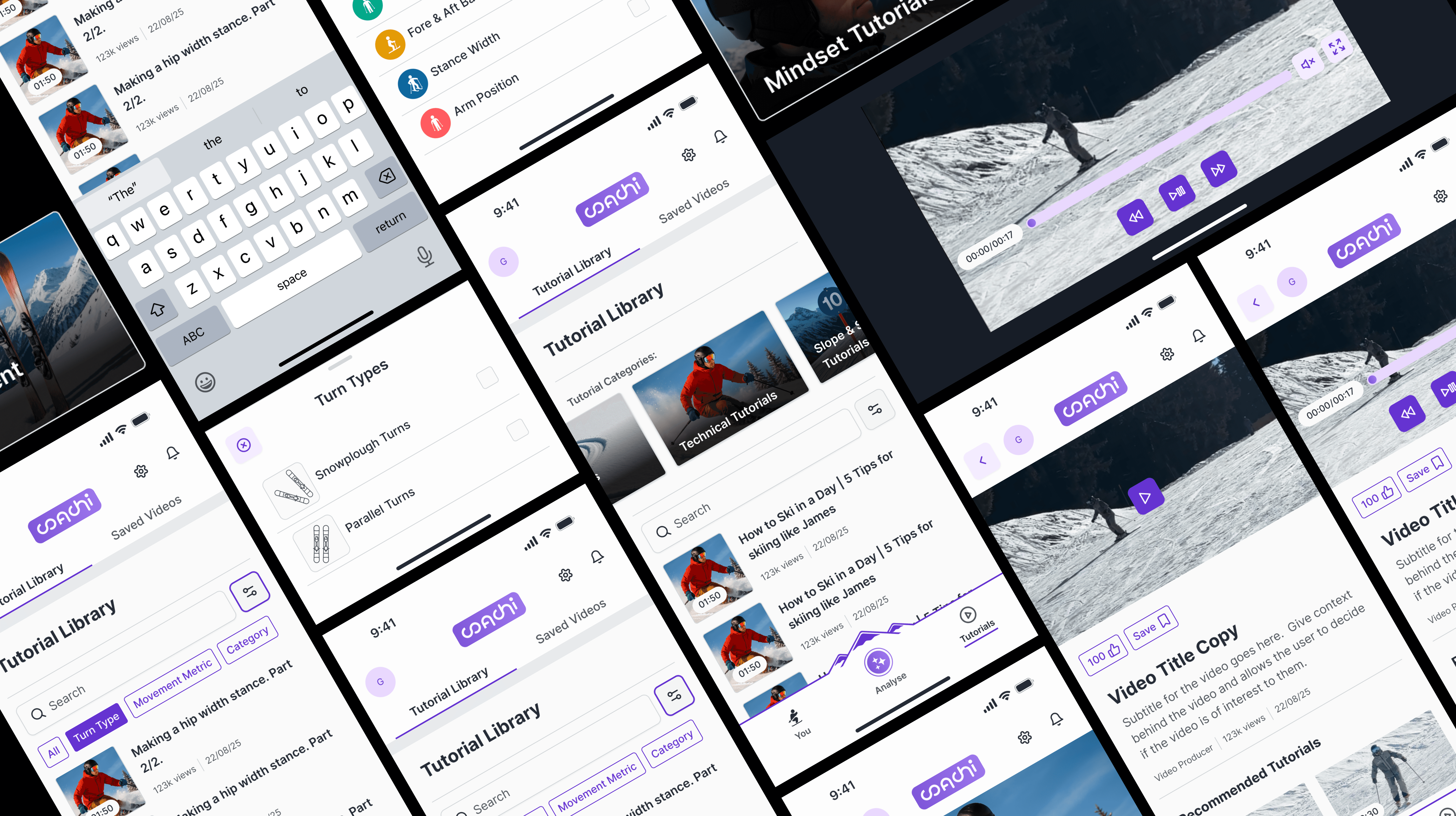
To support Coachi’s AI-driven feedback, I designed a library of tutorial videos that enhances the learning experience for skiers. These videos are not just stand-alone resources — they are integrated into the feedback journey, with recommended tutorials displayed alongside AI-generated coaching insights.
This ensures that every learner receives not only personalised analysis but also actionable guidance to improve their performance.
The Context
To support Coachi’s AI-driven feedback, I designed a library of tutorial videos that enhances the learning experience for skiers. These videos are not just stand-alone resources — they are integrated into the feedback journey, with recommended tutorials displayed alongside AI-generated coaching insights.
This ensures that every learner receives not only personalised analysis but also actionable guidance to improve their performance.
My Approach
Through research with ski instructors, I uncovered how they evaluate a skier’s performance: by diagnosing issues across six key domains of performance:
Technical issues
Tactical issues
Environmental issues
Physical issues
Psychological issues
Equipment issues
This framework became the foundation for the information architecture (IA) of the tutorial library.
My Approach
Through research with ski instructors, I uncovered how they evaluate a skier’s performance: by diagnosing issues across six key domains of performance:
Technical issues
Tactical issues
Environmental issues
Physical issues
Psychological issues
Equipment issues
This framework became the foundation for the information architecture (IA) of the tutorial library.
Skills Demonstrated
UX research & synthesis
Information architecture design
Metadata & CMS strategy
Design for content discovery
Scalable content system design
[Impact]
Mapped 100% of Instructor Evaluations into Scalable IA
Structured 100% of tutorial content using a six-domain coaching framework uncovered through research with 10+ ski instructors, creating an intuitive, performance-aligned library that mirrors how real instructors diagnose skill issues.
Enabled AI to Deliver Personalised Content via Metadata-Driven Tagging
Designed a CMS tagging system that links tutorial videos to user goals and feedback data; early testing showed that 88% of users rated the recommended content as “useful” or “highly relevant” — validating the system’s personalisation logic.
Improved Tutorial Discovery by 60%
Usability testing of the library UI revealed a 60% improvement in content findability over baseline navigation, driven by the addition of performance-domain filters and a carousel-based content layout.
[My Process]

1. Information Architecture
Categorised tutorials using five coaching domains uncovered through user research, mirroring how instructors assess performance.
This improved discoverability, supported intelligent AI recommendations, and created a scalable content structure.
1. Information Architecture
Categorised tutorials using five coaching domains uncovered through user research, mirroring how instructors assess performance.
This improved discoverability, supported intelligent AI recommendations, and created a scalable content structure.
2. Navigation & Design

Intuitive Navigation Aligned with Coaching Methods
Designed a category carousel and smart filters to help users browse by coaching domain or drill into specific needs.
Balanced exploration and precision to reduce cognitive load and boost learner confidence in content discovery.
2. Navigation & Design
Intuitive Navigation Aligned with Coaching Methods
Designed a category carousel and smart filters to help users browse by coaching domain or drill into specific needs.
Balanced exploration and precision to reduce cognitive load and boost learner confidence in content discovery.
3. CMS & Metadata Strategy
Smart Metadata for Scalable Personalisation:

Built a tagging framework linking each video to performance domain, skill level, and objectives.
Enabled seamless scaling, improved searchability, and powered real-time AI recommendations aligned to learner feedback.
3. CMS & Metadata Strategy
Smart Metadata for Scalable Personalisation:
Built a tagging framework linking each video to performance domain, skill level, and objectives.
Enabled seamless scaling, improved searchability, and powered real-time AI recommendations aligned to learner feedback.
[Key Learnings]
Design Grounded in Domain Expertise
Learned how to translate expert mental models (instructor evaluation methods) into scalable IA — reinforcing the importance of aligning UX with real-world thinking.
System Thinking Improves Longevity
Saw firsthand how a well-structured taxonomy and metadata model supports both short-term usability and long-term product scalability.
Navigation Is Strategy, Not Just UI
Recognised that navigation design directly shapes user confidence, discoverability, and learning outcomes — especially when tailored to authentic workflows.
[Persona]
Jhon Roberts
Marketing Manager
Content
Age: 29
Location: New York City
Tech Proficiency: Moderate
Gender: Male
[Goal]
Quickly complete purchases without interruptions.
Trust the platform to handle her payment securely.
Access a seamless mobile shopping experience.
[Frustrations]
Long or confusing checkout processes.
Error messages that don’t explain the issue.
Poor mobile optimization that slows her down.
[Overview]
The Context
To support Coachi’s AI-driven feedback, I designed a library of tutorial videos that enhances the learning experience for skiers. These videos are not just stand-alone resources — they are integrated into the feedback journey, with recommended tutorials displayed alongside AI-generated coaching insights.
This ensures that every learner receives not only personalised analysis but also actionable guidance to improve their performance.
The Context
To support Coachi’s AI-driven feedback, I designed a library of tutorial videos that enhances the learning experience for skiers. These videos are not just stand-alone resources — they are integrated into the feedback journey, with recommended tutorials displayed alongside AI-generated coaching insights.
This ensures that every learner receives not only personalised analysis but also actionable guidance to improve their performance.
My Approach
Through research with ski instructors, I uncovered how they evaluate a skier’s performance: by diagnosing issues across six key domains of performance:
Technical issues
Tactical issues
Environmental issues
Physical issues
Psychological issues
Equipment issues
This framework became the foundation for the information architecture (IA) of the tutorial library.
My Approach
Through research with ski instructors, I uncovered how they evaluate a skier’s performance: by diagnosing issues across six key domains of performance:
Technical issues
Tactical issues
Environmental issues
Physical issues
Psychological issues
Equipment issues
This framework became the foundation for the information architecture (IA) of the tutorial library.
Skills Demonstrated
UX research & synthesis
UX research & synthesis
Information architecture design
Information architecture design
Metadata & CMS strategy
Metadata & CMS strategy
Design for content discovery
Design for content discovery
[Impact]
Mapped 100% of Instructor Evaluations into Scalable IA
Structured 100% of tutorial content using a six-domain coaching framework uncovered through research with 10+ ski instructors, creating an intuitive, performance-aligned library that mirrors how real instructors diagnose skill issues.
Enabled AI to Deliver Personalised Content via Metadata-Driven Tagging
Designed a CMS tagging system that links tutorial videos to user goals and feedback data; early testing showed that 88% of users rated the recommended content as “useful” or “highly relevant” — validating the system’s personalisation logic.
Improved Tutorial Discovery by 60%
Built a CMS tagging model and metadata strategy that supports future content growth and seamless AI integration — enhancing both UX and internal content operations.
[My Process]
1. Information Architecture
Categorised tutorials using five coaching domains uncovered through user research, mirroring how instructors assess performance.
This improved discoverability, supported intelligent AI recommendations, and created a scalable content structure.
1. Information Architecture
Categorised tutorials using five coaching domains uncovered through user research, mirroring how instructors assess performance.
This improved discoverability, supported intelligent AI recommendations, and created a scalable content structure.
2. Navigation & Design
Intuitive Navigation Aligned with Coaching Methods
Designed a category carousel and smart filters to help users browse by coaching domain or drill into specific needs.
Balanced exploration and precision to reduce cognitive load and boost learner confidence in content discovery.
2. Navigation & Design
Intuitive Navigation Aligned with Coaching Methods
Designed a category carousel and smart filters to help users browse by coaching domain or drill into specific needs.
Balanced exploration and precision to reduce cognitive load and boost learner confidence in content discovery.
3. CMS & Metadata Strategy
Smart Metadata for Scalable Personalisation:
Built a tagging framework linking each video to performance domain, skill level, and objectives.
Enabled seamless scaling, improved searchability, and powered real-time AI recommendations aligned to learner feedback.
3. CMS & Metadata Strategy
Smart Metadata for Scalable Personalisation:
Built a tagging framework linking each video to performance domain, skill level, and objectives.
Enabled seamless scaling, improved searchability, and powered real-time AI recommendations aligned to learner feedback.
[Key Learnings]
Design Grounded in Domain Expertise
Learned how to translate expert mental models (instructor evaluation methods) into scalable IA — reinforcing the importance of aligning UX with real-world thinking.
System Thinking Improves Longevity
Saw firsthand how a well-structured taxonomy and metadata model supports both short-term usability and long-term product scalability.
Navigation Is Strategy, Not Just UI
Recognised that navigation design directly shapes user confidence, discoverability, and learning outcomes — especially when tailored to authentic workflows.