Participatory Design

[Participatory Design Overview]
The Context
For me, participatory design is about designing with people, not just for them. It means bringing users, stakeholders, and technical teams into the design process early and often — not as passive reviewers, but as active co-creators.
I see it as a way to build shared ownership, uncover insights that wouldn’t emerge in isolation, and align product decisions with real-world needs. By facilitating collaboration across disciplines, I ensure that solutions are not only user-centred but also feasible, scalable, and strategically valuable.
In the sections that follow, I’ll share information on two case studies, as examples of how I’ve applied participatory design in practice:
Designing the Dynamics CRM Support Suite
Mobile App Research Workshop
The Context
For me, participatory design is about designing with people, not just for them. It means bringing users, stakeholders, and technical teams into the design process early and often — not as passive reviewers, but as active co-creators.
I see it as a way to build shared ownership, uncover insights that wouldn’t emerge in isolation, and align product decisions with real-world needs. By facilitating collaboration across disciplines, I ensure that solutions are not only user-centred but also feasible, scalable, and strategically valuable.
In the sections that follow, I’ll share information on two case studies, as examples of how I’ve applied participatory design in practice:
Designing the Dynamics CRM Support Suite
Mobile App Research Workshop
1. Designing the Dynamics CRM Support Suite
Collaborating with engineers and MSPs to co-create scalable tools that empower non-technical users to manage and maintain CRM environments.
1. Designing the Dynamics CRM Support Suite
Collaborating with engineers and MSPs to co-create scalable tools that empower non-technical users to manage and maintain CRM environments.
2. Mobile App Research Workshops
Facilitating co-creation with expert ski instructors to define the movement metrics behind an AI-driven coaching app.
2. Mobile App Research Workshops
Facilitating co-creation with expert ski instructors to define the movement metrics behind an AI-driven coaching app.
[1.1 Designing the Dynamics CRM Support Suite]
The Context
As part of the Dynamics SaaS ecosystem, I led the strategy and design of a support suite for SMB-focused Managed Service Providers (MSPs). The suite included three core tools:
1. Data Importer: Seamless migration of customer data.
2. Advanced Settings Tool: Rapid provisioning of customers system.
3. Roles Tool: Easy assignment of user access and permissions.
The Context
As part of the Dynamics SaaS ecosystem, I led the strategy and design of a support suite for SMB-focused Managed Service Providers (MSPs). The suite included three core tools:
1. Data Importer: Seamless migration of customer data.
2. Advanced Settings Tool: Rapid provisioning of customers system.
3. Roles Tool: Easy assignment of user access and permissions.
The Challenge
MSPs adopting off-the-shelf CRM solutions lacked in-house Dynamics expertise but still needed to provision, configure, and maintain CRMs for their customers. The SaaS directors recognised the need for scalable, intuitive tools that could lower this technical barrier while also opening new service revenue opportunities.
The Challenge
MSPs adopting off-the-shelf CRM solutions lacked in-house Dynamics expertise but still needed to provision, configure, and maintain CRMs for their customers. The SaaS directors recognised the need for scalable, intuitive tools that could lower this technical barrier while also opening new service revenue opportunities.
Skills Demonstrated
Miro
Figma
Cross-functional collaboration
Participatory design leadership
UX strategy for SaaS
[1.2 The Impact]
80% Support Service Coverage
Designed three support tools that empowered non-technical MSPs to manage CRM tasks independently, reducing reliance on engineering support and scaling onboarding success.
Converted 2 Years of Support Data into a Scalable Toolset
Co-analysed undocumented support logs with developers to surface high-frequency issues, then translated these into user-friendly, task-focused tools grounded in real-world usage patterns.
Defined a Tiered Support Model, Driving Adoption & Revenue
Co-created a sustainable service framework balancing self-service tools, learning resources, and optional engineering support — reducing friction for new customers and creating upsell pathways.
[1.3 My Process]

Participatory Design in Action
1. Co-analysis with Engineers
Audited two years of undocumented service tickets together, categorising issues by what, why, and how they were resolved
2. Synthesis Workshops
Grouped findings into themes to prioritise high-frequency, high-impact support needs.
3. Iterative Design Reviews
Translated complex technical workflows into intuitive task-based UIs, refining through developer feedback and usability validation.
4. Strategy Co-Creation
Partnered with leadership to define a tiered support model combining self-service tools, learning resources, and optional engineering services.
Participatory Design in Action
1. Co-analysis with Engineers
Audited two years of undocumented service tickets together, categorising issues by what, why, and how they were resolved
2. Synthesis Workshops
Grouped findings into themes to prioritise high-frequency, high-impact support needs.
3. Iterative Design Reviews
Translated complex technical workflows into intuitive task-based UIs, refining through developer feedback and usability validation.
4. Strategy Co-Creation
Partnered with leadership to define a tiered support model combining self-service tools, learning resources, and optional engineering services.
[1.4 Key Learnings]
Data-Led Collaboration Enables Smart Prioritisation
Auditing real support tickets with engineers clarified what mattered most. Co-analysis sessions turned undocumented chaos into structured design priorities, driving faster, more focused product decisions.
Participatory Design Drives Developer Buy-In
Iterative reviews built shared understanding and better outcomes. By involving developers in usability feedback loops, I translated technical workflows into intuitive UI — without losing the nuance of the backend systems.
Scalable Strategy Comes from Shared Insight
Strategic co-creation bridged business, UX, and technical needs. Partnering with leadership and engineers resulted in a tiered support model that lowered onboarding friction, boosted adoption, and unlocked new service revenue streams.
[2.1 Mobile App Research Workshop Overview]
The Context
Coachi is an AI-driven ski coaching app designed to help beginner and intermediate skiers improve through real-time movement analysis and remote instructor feedback.
The Context
Coachi is an AI-driven ski coaching app designed to help beginner and intermediate skiers improve through real-time movement analysis and remote instructor feedback.
The Challenge
One of the biggest challenges was determining which movement metrics should form the foundation of the AI feedback system. These metrics needed to:
Provide clear, actionable insights to skiers.
Allow instructors to remotely monitor progress.
Enable new service opportunities such as personalised lesson upsells.
The Challenge
One of the biggest challenges was determining which movement metrics should form the foundation of the AI feedback system. These metrics needed to:
Provide clear, actionable insights to skiers.
Allow instructors to remotely monitor progress.
Enable new service opportunities such as personalised lesson upsells.
Skills Demonstrated
Miro
Miro
Research workshop facilitation
Research workshop facilitation
Participatory design leadership
Participatory design leadership
Affinity mapping
Affinity mapping
[2.2 The Impact]
Reliable, AI-ready movement framework
Facilitated participatory workshops with elite ski instructors to define four core movement metrics, directly enabling accurate, data-driven feedback for skiers and remote performance tracking for coaches.
Bridged Coaching Expertise with AI Product Strategy
Translated expert coaching insights into trackable joint-based metrics, aligning product features with real-world instructional practices and unlocking new upsell opportunities for personalised coaching.
Users, Instructors, & Product Teams Alignment
Used co-creation and affinity mapping to build shared ownership across disciplines, reducing ambiguity in product direction and strengthening business–user–technology alignment.
[2.3 My Process]

Participatory Design in Action
1. Collaborative Brainstorming
Identified the most common faults in beginner–intermediate skiing.
2. Affinity Mapping
Grouped and synthesised faults to uncover recurring themes.
3. Expert Validation
Defined four core technical movement metrics, each mapped to joint positions measurable by body tracking technology.
Participatory Design in Action
1. Collaborative Brainstorming
Identified the most common faults in beginner–intermediate skiing.
2. Affinity Mapping
Grouped and synthesised faults to uncover recurring themes.
3. Expert Validation
Defined four core technical movement metrics, each mapped to joint positions measurable by body tracking technology.
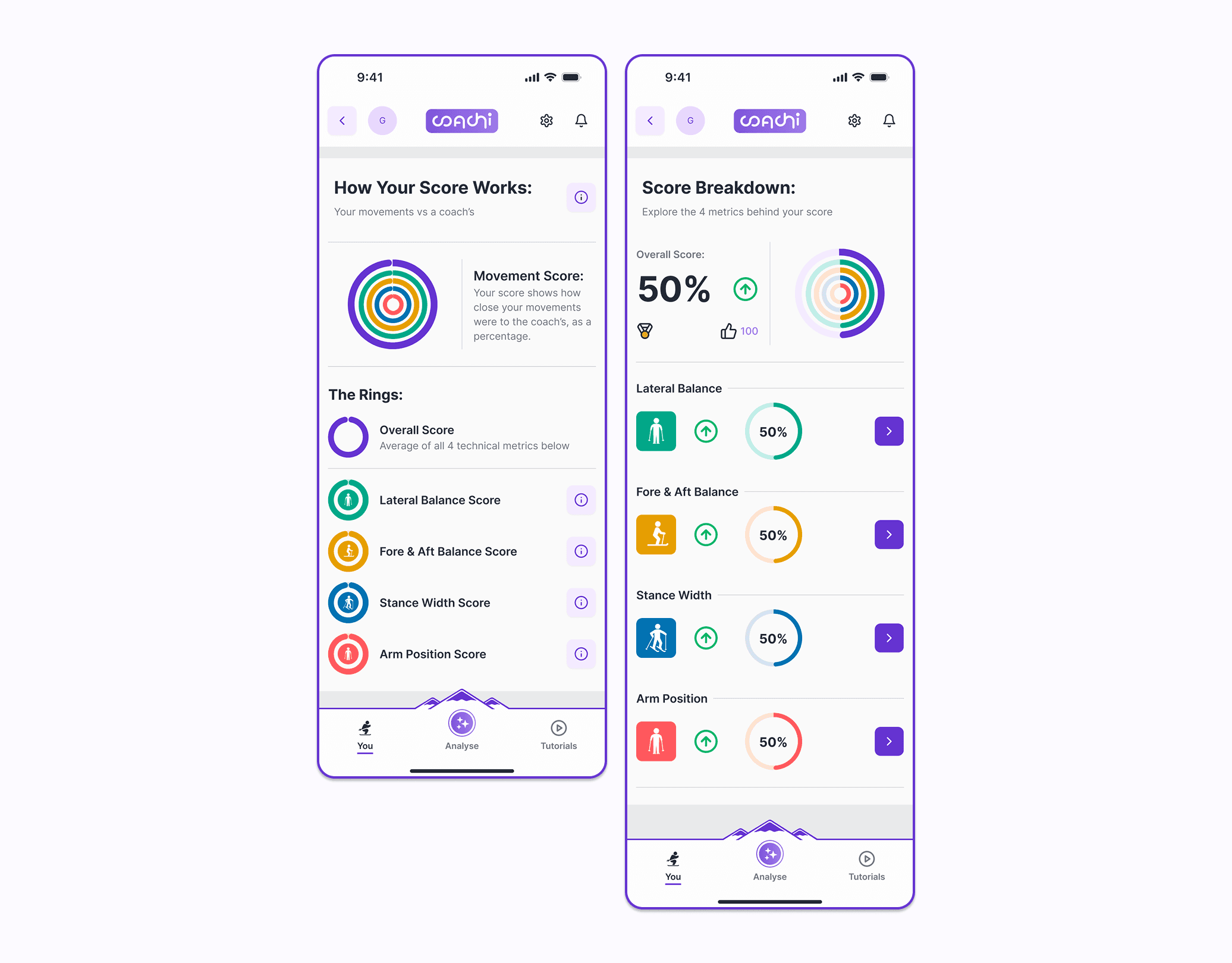
Coachi Movement Metrics
1. Overall Score
A single percentage that reflects how closely a skier’s movements match a benchmarked expert demo (snowplough or parallel). It provides an at-a-glance snapshot of overall technique quality.
2. Lateral Balance
Measures side-to-side body lean during turns. This reflects how well a skier manages edge grip and lateral stability. Good lateral balance means the skier stays centred over their skis — essential for controlled carving and smooth turns.
3. Fore & Aft Balance
Assesses forward/backward weight distribution. Skiers with strong fore/aft balance maintain pressure on the front of the boot, enabling better control, reduced fatigue, and easier initiation of turns.
4. Stance Width
Tracks how far apart the skis are during movement. A correct stance supports both agility and balance. Too narrow or too wide can inhibit steering or cause instability — especially critical in progressing from plough to parallel turns.
Coachi Movement Metrics
1. Overall Score
A single percentage that reflects how closely a skier’s movements match a benchmarked expert demo (snowplough or parallel). It provides an at-a-glance snapshot of overall technique quality.
2. Lateral Balance
Measures side-to-side body lean during turns. This reflects how well a skier manages edge grip and lateral stability. Good lateral balance means the skier stays centred over their skis — essential for controlled carving and smooth turns.
3. Fore & Aft Balance
Assesses forward/backward weight distribution. Skiers with strong fore/aft balance maintain pressure on the front of the boot, enabling better control, reduced fatigue, and easier initiation of turns.
4. Stance Width
Tracks how far apart the skis are during movement. A correct stance supports both agility and balance. Too narrow or too wide can inhibit steering or cause instability — especially critical in progressing from plough to parallel turns.
[2.4 Key Learnings]
Co-Creation Uncovers What Research Alone Misses
Bringing instructors into the design process surfaced real-world skiing patterns. Collaborative mapping of common faults revealed metrics that AI alone wouldn’t have prioritised — ensuring feedback felt authentic and actionable.
Expertise + Synthesis = Measurable Metrics
Facilitated synthesis turned qualitative insight into AI-ready data. Affinity mapping helped translate fuzzy movement language into structured metrics, directly linked to joint positions and tracking data.
Aligned Outcomes for All Stakeholders
Designing with both users and instructors built value across the ecosystem. The output supported skiers, empowered coaches, and opened new monetisation paths — showing that participatory design can serve user, product, and business goals simultaneously.
Designing with both users and instructors built value across the ecosystem. The output supported skiers, empowered coaches, and opened new monetisation paths — showing that participatory design can serve user, product, and business goals simultaneously.
[Persona]
Jhon Roberts
Marketing Manager
Content
Age: 29
Location: New York City
Tech Proficiency: Moderate
Gender: Male
[Goal]
Quickly complete purchases without interruptions.
Trust the platform to handle her payment securely.
Access a seamless mobile shopping experience.
[Frustrations]
Long or confusing checkout processes.
Error messages that don’t explain the issue.
Poor mobile optimization that slows her down.
[Participatory Design Overview]
The Context
For me, participatory design is about designing with people, not just for them. It means bringing users, stakeholders, and technical teams into the design process early and often — not as passive reviewers, but as active co-creators.
I see it as a way to build shared ownership, uncover insights that wouldn’t emerge in isolation, and align product decisions with real-world needs. By facilitating collaboration across disciplines, I ensure that solutions are not only user-centred but also feasible, scalable, and strategically valuable.
In the sections that follow, I’ll share information on two case studies, as examples of how I’ve applied participatory design in practice:
Designing the Dynamics CRM Support Suite
Mobile App Research Workshop
The Context
For me, participatory design is about designing with people, not just for them. It means bringing users, stakeholders, and technical teams into the design process early and often — not as passive reviewers, but as active co-creators.
I see it as a way to build shared ownership, uncover insights that wouldn’t emerge in isolation, and align product decisions with real-world needs. By facilitating collaboration across disciplines, I ensure that solutions are not only user-centred but also feasible, scalable, and strategically valuable.
In the sections that follow, I’ll share information on two case studies, as examples of how I’ve applied participatory design in practice:
Designing the Dynamics CRM Support Suite
Mobile App Research Workshop
2. Research Workshops
Facilitating co-creation with expert ski instructors to define the movement metrics behind an AI-driven coaching app.
2. Research Workshops
Facilitating co-creation with expert ski instructors to define the movement metrics behind an AI-driven coaching app.
1. Designing the Dynamics CRM Support Suite
Collaborating with engineers and MSPs to co-create scalable tools that empower non-technical users to manage and maintain CRM environments.
1. Designing the Dynamics CRM Support Suite
Collaborating with engineers and MSPs to co-create scalable tools that empower non-technical users to manage and maintain CRM environments.
[2.1 Mobile App Research Workshop Overview]
The Context
Coachi is an AI-driven ski coaching app designed to help beginner and intermediate skiers improve through real-time movement analysis and remote instructor feedback.
The Context
Coachi is an AI-driven ski coaching app designed to help beginner and intermediate skiers improve through real-time movement analysis and remote instructor feedback.
The Challenge
One of the biggest challenges was determining which movement metrics should form the foundation of the AI feedback system. These metrics needed to:
Provide clear, actionable insights to skiers.
Allow instructors to remotely monitor progress.
Enable new service opportunities such as personalised lesson upsells.
The Challenge
One of the biggest challenges was determining which movement metrics should form the foundation of the AI feedback system. These metrics needed to:
Provide clear, actionable insights to skiers.
Allow instructors to remotely monitor progress.
Enable new service opportunities such as personalised lesson upsells.
Skills Demonstrated
Miro
Miro
Research workshop facilitation
Research workshop facilitation
Participatory design leadership
Participatory design leadership
Affinity mapping
Affinity mapping
[2.2 The Impact]
Reliable, AI-ready movement framework
Facilitated participatory workshops with elite ski instructors to define four core movement metrics, directly enabling accurate, data-driven feedback for skiers and remote performance tracking for coaches.
Bridged Coaching Expertise with AI Product Strategy
Translated expert coaching insights into trackable joint-based metrics, aligning product features with real-world instructional practices and unlocking new upsell opportunities for personalised coaching.
Users, Instructors, & Product Teams Alignment
Used co-creation and affinity mapping to build shared ownership across disciplines, reducing ambiguity in product direction and strengthening business–user–technology alignment.
[2.3 My Process]
Participatory Design in Action
1. Collaborative Brainstorming
Identified the most common faults in beginner–intermediate skiing.
2. Affinity Mapping
Grouped and synthesised faults to uncover recurring themes.
3. Expert Validation
Defined four core technical movement metrics, each mapped to joint positions measurable by body tracking technology.
Participatory Design in Action
1. Collaborative Brainstorming
Identified the most common faults in beginner–intermediate skiing.
2. Affinity Mapping
Grouped and synthesised faults to uncover recurring themes.
3. Expert Validation
Defined four core technical movement metrics, each mapped to joint positions measurable by body tracking technology.
Coachi Movement Metrics
1. Overall Score
A single percentage that reflects how closely a skier’s movements match a benchmarked expert demo (snowplough or parallel). It provides an at-a-glance snapshot of overall technique quality.
2. Lateral Balance
Measures side-to-side body lean during turns. This reflects how well a skier manages edge grip and lateral stability. Good lateral balance means the skier stays centred over their skis — essential for controlled carving and smooth turns.
3. Fore & Aft Balance
Assesses forward/backward weight distribution. Skiers with strong fore/aft balance maintain pressure on the front of the boot, enabling better control, reduced fatigue, and easier initiation of turns.
4. Stance Width
Tracks how far apart the skis are during movement. A correct stance supports both agility and balance. Too narrow or too wide can inhibit steering or cause instability — especially critical in progressing from plough to parallel turns.
Coachi Movement Metrics
1. Overall Score
A single percentage that reflects how closely a skier’s movements match a benchmarked expert demo (snowplough or parallel). It provides an at-a-glance snapshot of overall technique quality.
2. Lateral Balance
Measures side-to-side body lean during turns. This reflects how well a skier manages edge grip and lateral stability. Good lateral balance means the skier stays centred over their skis — essential for controlled carving and smooth turns.
3. Fore & Aft Balance
Assesses forward/backward weight distribution. Skiers with strong fore/aft balance maintain pressure on the front of the boot, enabling better control, reduced fatigue, and easier initiation of turns.
4. Stance Width
Tracks how far apart the skis are during movement. A correct stance supports both agility and balance. Too narrow or too wide can inhibit steering or cause instability — especially critical in progressing from plough to parallel turns.
[2.4 Key Learnings]
Co-Creation Uncovers What Research Alone Misses
Bringing instructors into the design process surfaced real-world skiing patterns. Collaborative mapping of common faults revealed metrics that AI alone wouldn’t have prioritised — ensuring feedback felt authentic and actionable.
Expertise + Synthesis = Measurable Metrics
Facilitated synthesis turned qualitative insight into AI-ready data. Affinity mapping helped translate fuzzy movement language into structured metrics, directly linked to joint positions and tracking data.
Aligned Outcomes for All Stakeholders
Designing with both users and instructors built value across the ecosystem. The output supported skiers, empowered coaches, and opened new monetisation paths — showing that participatory design can serve user, product, and business goals simultaneously.
[1.1 Designing the Dynamics CRM Support Suite]
The Context
As part of the Dynamics SaaS ecosystem, I led the strategy and design of a support suite for SMB-focused Managed Service Providers (MSPs). The suite included three core tools:
1. Data Importer: Seamless migration of customer data.
2. Advanced Settings Tool: Seamless migration of customer data.
3. Roles Tool: Easy assignment of user access and permissions.
The Context
As part of the Dynamics SaaS ecosystem, I led the strategy and design of a support suite for SMB-focused Managed Service Providers (MSPs). The suite included three core tools:
1. Data Importer: Seamless migration of customer data.
2. Advanced Settings Tool: Seamless migration of customer data.
3. Roles Tool: Easy assignment of user access and permissions.
The Challenge
MSPs adopting off-the-shelf CRM solutions lacked in-house Dynamics expertise but still needed to provision, configure, and maintain CRMs for their customers. The SaaS directors recognised the need for scalable, intuitive tools that could lower this technical barrier while also opening new service revenue opportunities.
The Challenge
MSPs adopting off-the-shelf CRM solutions lacked in-house Dynamics expertise but still needed to provision, configure, and maintain CRMs for their customers. The SaaS directors recognised the need for scalable, intuitive tools that could lower this technical barrier while also opening new service revenue opportunities.
Skills Demonstrated
Miro
Miro
Figma
Figma
Cross-functional collaboration
Cross-functional collaboration
Participatory design leadership
Participatory design leadership
UX strategy for SaaS
UX strategy for SaaS
[1.2 The Impact]
80% Support Service Coverage
Designed three support tools that empowered non-technical MSPs to manage CRM tasks independently, reducing reliance on engineering support and scaling onboarding success.
Converted 2 Years of Support Data into a Scalable Toolset
Co-analysed undocumented support logs with developers to surface high-frequency issues, then translated these into user-friendly, task-focused tools grounded in real-world usage patterns.
Defined a Tiered Support Model, Driving Adoption & Revenue
Co-created a sustainable service framework balancing self-service tools, learning resources, and optional engineering support — reducing friction for new customers and creating upsell pathways.
[1.3 My Process]
Participatory Design in Action
1. Co-analysis with Engineers
Audited two years of undocumented service tickets together, categorising issues by what, why, and how they were resolved
2. Synthesis Workshops
Grouped findings into themes to prioritise high-frequency, high-impact support needs.
3. Iterative Design Reviews
Translated complex technical workflows into intuitive task-based UIs, refining through developer feedback and usability validation.
4. Strategy Co-Creation
Partnered with leadership to define a tiered support model combining self-service tools, learning resources, and optional engineering services.
Participatory Design in Action
1. Co-analysis with Engineers
Audited two years of undocumented service tickets together, categorising issues by what, why, and how they were resolved
2. Synthesis Workshops
Grouped findings into themes to prioritise high-frequency, high-impact support needs.
3. Iterative Design Reviews
Translated complex technical workflows into intuitive task-based UIs, refining through developer feedback and usability validation.
4. Strategy Co-Creation
Partnered with leadership to define a tiered support model combining self-service tools, learning resources, and optional engineering services.
[1.4 Key Learnings]
Data-Led Collaboration Enables Smart Prioritisation
Auditing real support tickets with engineers clarified what mattered most. Co-analysis sessions turned undocumented chaos into structured design priorities, driving faster, more focused product decisions.
Participatory Design Drives Developer Buy-In
Iterative reviews built shared understanding and better outcomes. By involving developers in usability feedback loops, I translated technical workflows into intuitive UI — without losing the nuance of the backend systems.
Scalable Strategy Comes from Shared Insight
Strategic co-creation bridged business, UX, and technical needs. Partnering with leadership and engineers resulted in a tiered support model that lowered onboarding friction, boosted adoption, and unlocked new service revenue streams.